
EU Green Claims Rules 2026: EmpCo Explained
A practical guide to EmpCo’s green-claims rules, how they differ from the pending Green Claims proposal, and what businesses should review.
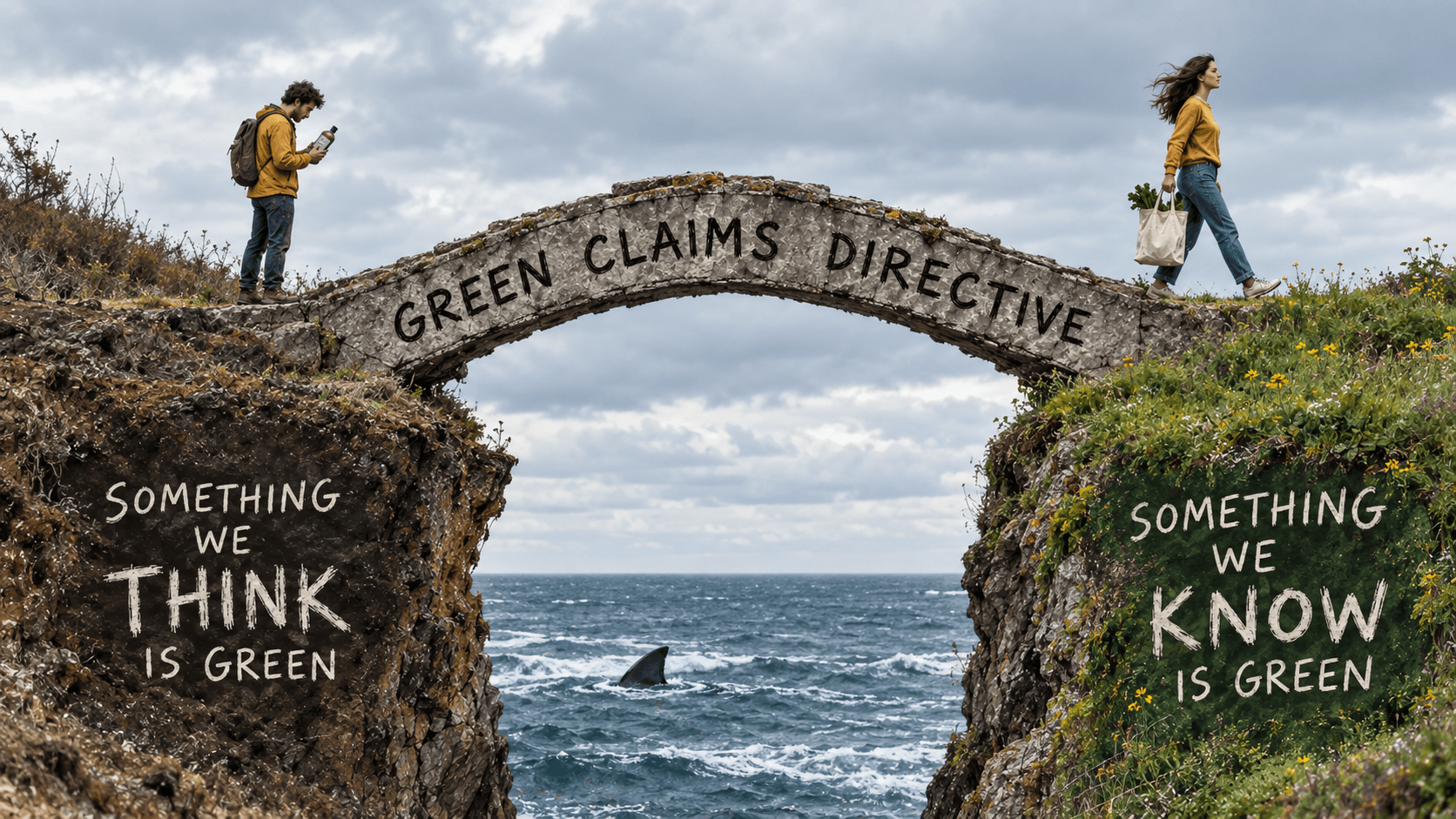
Headlines about the proposed Green Claims Directive have sometimes made it sound as though the EU has stepped back from greenwashing rules. That misses a separate law already on the books. Directive (EU) 2024/825, known as the Empowering Consumers for the Green Transition Directive or EmpCo, is in application from 27 September 2026. It changes existing consumer-protection rules on environmental claims, sustainability labels and product durability.
The distinction matters. The Green Claims Directive, proposed as COM(2023) 166, remains a legislative proposal; EUR-Lex lists its procedure as ongoing. EmpCo is an adopted directive that Member States had to transpose into national law. For businesses, the rules to check today are the national measures implementing EmpCo and the existing consumer-protection framework.
Who is covered, and what counts as a claim
EmpCo amends the Unfair Commercial Practices Directive (UCPD) and the Consumer Rights Directive. Its green-claims rules address business-to-consumer commercial practices: what a trader tells consumers before, during or after a transaction. They are not a general rule for every business statement or every sustainability report. A mandatory disclosure required by EU or national law is excluded from the UCPD definition of an environmental claim. But if a business reuses information from a mandatory report in voluntary advertising aimed at consumers, that marketing can fall within the rules.
The focus is how a product, service or business is presented, including through text, names, labels, symbols and imagery. A green leaf or an environmental-sounding product name can contribute to an implied claim, depending on the full presentation and what consumers are likely to understand. The rules apply to consumer-facing claims in the EU market, so teams should review packaging, product pages, advertising and other customer communications together.
Twelve practices that are unfair in every case
EmpCo adds twelve practices to the UCPD’s blacklist. A practice on this list is treated as unfair without a separate case-by-case assessment of whether it influenced a consumer’s decision.
Five entries deal directly with environmental claims and labels. They prohibit:
- displaying a sustainability label that is neither based on a qualifying certification scheme nor established by a public authority;
- making a generic environmental claim without recognised excellent environmental performance relevant to that claim;
- presenting a product or business as a whole as having a benefit when the claim concerns only one aspect;
- claiming that a product has a neutral, reduced or positive greenhouse-gas impact when the claim is based on offsetting emissions; and
- presenting a legal requirement that applies to all products in the relevant category as a distinguishing feature of one offer.
The other seven entries address durability and repair. They cover withholding information that a software update will impair a product; presenting a feature-only update as necessary; promoting goods with a deliberately limiting durability feature when the trader knows about it; making false durability claims; describing a product as repairable when it is not; encouraging replacement or replenishment of consumables earlier than technically necessary; and withholding, or falsely asserting, that non-original parts or consumables will impair functionality.
Four further rules depend on the facts
The blacklist is only part of the change. In case-by-case assessments of whether a commercial practice misleads consumers, environmental and social characteristics now form part of a product’s main characteristics. The same applies to circularity features such as durability, reparability and recyclability.
Claims about future environmental performance need particular care. They must be supported by clear, objective and publicly available commitments set out in a detailed, realistic implementation plan. The plan must include measurable, time-bound targets. Progress must be checked periodically by an independent third party, and its findings must be made available to consumers.
The amended rules also address claims that present an irrelevant feature as a benefit and environmental or social comparisons between products. A comparison must give consumers relevant information about the method used, the products compared and their suppliers. These assessments still depend on the facts and the overall presentation.
National implementation shapes enforcement
Member States had to adopt and publish transposing measures by 27 March 2026 and apply them from 27 September 2026. The Directive sets a common framework, while businesses need to check the national rules and enforcement arrangements in every market where they make consumer-facing claims. A campaign running across several countries can therefore require review against several national texts.
The UCPD also provides minimum levels for maximum fines in certain widespread infringements with a Union dimension: at least 4% of the trader’s annual turnover in the affected Member State or Member States, or at least €2 million when turnover information is unavailable. The precise national measures and the facts of an alleged infringement still matter; those figures are not a general fine automatically attached to every unsupported claim.
Evidence has to match the claim
Start with an inventory of claims across packaging, advertising, product pages and sponsorships. For each factual claim, keep evidence that matches the product, the scope of the statement and the period it covers. A more specific statement can help consumers understand what is being claimed, but specificity alone does not make it true or compliant. “Packaging made with 100% renewable electricity,” for example, still needs evidence that supports the percentage and explains what part of production it covers.
The same care applies to sustainability labels. A company-created badge does not qualify just because it has a logo and a set of internal criteria. The label must be established by a public authority or rest on a certification scheme meeting the Directive’s requirements, including third-party verification. For claims about future environmental performance, independent periodic verification is expressly required. EmpCo does not impose a blanket third-party audit on every environmental claim, but traders should be able to support objective claims if a consumer authority or court asks for the evidence.
Existing stock needs a practical transition plan
The new rules apply from 27 September 2026 to consumer-facing claims, including claims on products or packaging already in the supply chain. There is no general grandfathering rule. That does not mean every old package must automatically be destroyed or recalled: the Commission’s services describe practical corrections such as stickers or supplementary information near the affected products, while the CPC Network’s common understanding calls for proportionate, case-by-case enforcement when genuine transition difficulties arise.
Businesses should act promptly: update online claims, correct advertising, adapt future packaging and document reasonable steps for existing stock. The old-stock approach is an enforcement transition, not an open-ended exemption from the rules.
Conclusion
EmpCo is already part of the consumer-protection framework businesses must work with, while the separate Green Claims proposal remains pending. Its twelve blacklist entries make some practices plainly unfair; its case-by-case rules still require evidence and context. Neither a label nor a specific-sounding claim speaks for itself. The practical task is to connect every consumer-facing environmental message to evidence that explains exactly what it covers, and to check that message against the national rules in each market.
This article is for general information only and does not constitute legal advice.
Sources
- Empowering Consumers for the Green Transition — Directive (EU) 2024/825 — EUR-Lex
- Unfair Commercial Practices Directive 2005/29/EC — consolidated text of 27 September 2026 — EUR-Lex
- Consumer Rights Directive 2011/83/EU — consolidated text of 27 September 2026 — EUR-Lex
- Proposed Green Claims Directive COM(2023) 166 — proposal text — EUR-Lex
- Commission Questions and Answers on the Empowering Consumers Directive
- CPC Network common understanding on old stock — European Commission
- Green Claims proposal, procedure 2023/0085 — EUR-Lex